
Fairy Tales by Hans Christian AndersenWeek 10: European Fairy Tales - Assignments - Reading - Resources - Images |
|
|
|
|
The Ugly DucklingReading time: 3 minutes. Word count: 600 words. |
 |
 It
would be very sad, were I to relate all the misery and privations which the
poor little duckling endured during the hard winter; but when it had passed,
he found himself lying one morning in a moor, amongst the rushes. He felt the
warm sun shining, and heard the lark singing, and saw that all around was beautiful
spring. Then the young bird felt that his wings were strong, as he flapped them
against his sides, and rose high into the air. They bore him onwards, until
he found himself in a large garden, before he well knew how it had happened.
The apple-trees were in full blossom, and the fragrant elders bent their long
green branches down to the stream which wound round a smooth lawn. Everything
looked beautiful, in the freshness of early spring. From a thicket close by
came three beautiful white swans, rustling their feathers, and swimming lightly
over the smooth water. The duckling remembered the lovely birds, and felt more
strangely unhappy than ever.
It
would be very sad, were I to relate all the misery and privations which the
poor little duckling endured during the hard winter; but when it had passed,
he found himself lying one morning in a moor, amongst the rushes. He felt the
warm sun shining, and heard the lark singing, and saw that all around was beautiful
spring. Then the young bird felt that his wings were strong, as he flapped them
against his sides, and rose high into the air. They bore him onwards, until
he found himself in a large garden, before he well knew how it had happened.
The apple-trees were in full blossom, and the fragrant elders bent their long
green branches down to the stream which wound round a smooth lawn. Everything
looked beautiful, in the freshness of early spring. From a thicket close by
came three beautiful white swans, rustling their feathers, and swimming lightly
over the smooth water. The duckling remembered the lovely birds, and felt more
strangely unhappy than ever.
"I will fly to those royal birds," he exclaimed, "and they will kill me, because I am so ugly, and dare to approach them; but it does not matter: better be killed by them than pecked by the ducks, beaten by the hens, pushed about by the maiden who feeds the poultry, or starved with hunger in the winter."
Then he flew to the water, and swam towards the beautiful swans. The moment they espied the stranger, they rushed to meet him with outstretched wings.
"Kill me," said the poor bird; and he bent his head down to the surface of the water, and awaited death.
But
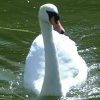
what did he see in the clear stream below? His own image; no longer a dark,
gray bird, ugly and disagreeable to look at, but a graceful and beautiful swan.
To be born in a duck's nest, in a farmyard, is of no consequence to a bird,
if it is hatched from a swan's egg. He now felt glad at having suffered sorrow
and trouble, because it enabled him to enjoy so much better all the pleasure
and happiness around him; for the great swans swam round the new-comer, and
stroked his neck with their beaks, as a welcome.
Into the garden presently came some little children, and threw bread and cake into the water.
"See," cried the youngest, "there is a new one;" and the rest were delighted, and ran to their father and mother, dancing and clapping their hands, and shouting joyously, "There is another swan come; a new one has arrived."
 Then
they threw more bread and cake into the water, and said, "The new one is
the most beautiful of all; he is so young and pretty." And the old swans
bowed their heads before him. Then he felt quite ashamed,
and hid his head under his wing; for he did not know what to do, he was so happy,
and yet not at all proud. He had been persecuted and despised for his ugliness,
and now he heard them say he was the most beautiful of all the birds. Even the
elder-tree bent down its bows into the water before him, and the sun shone warm
and bright. Then he rustled his feathers, curved his slender neck, and cried
joyfully, from the depths of his heart, "I never dreamed of such happiness
as this, while I was an ugly duckling."
Then
they threw more bread and cake into the water, and said, "The new one is
the most beautiful of all; he is so young and pretty." And the old swans
bowed their heads before him. Then he felt quite ashamed,
and hid his head under his wing; for he did not know what to do, he was so happy,
and yet not at all proud. He had been persecuted and despised for his ugliness,
and now he heard them say he was the most beautiful of all the birds. Even the
elder-tree bent down its bows into the water before him, and the sun shone warm
and bright. Then he rustled his feathers, curved his slender neck, and cried
joyfully, from the depths of his heart, "I never dreamed of such happiness
as this, while I was an ugly duckling."
|
Questions. Make sure you can answer these questions about what you just read:
Source: Hans Christian Andersen, Fairy Tales and Stories. English Translation: H. P. Paull (1872). Weblink. |
|
|
Modern
Languages / Anthropology 3043: Folklore & Mythology.
Laura Gibbs, Ph.D.
This work is licensed under a Creative
Commons License.
You must give the original author credit. You may not use this work for commercial
purposes. If you alter, transform, or build upon this work, you may distribute
the resulting work only under a license identical to this one. |
